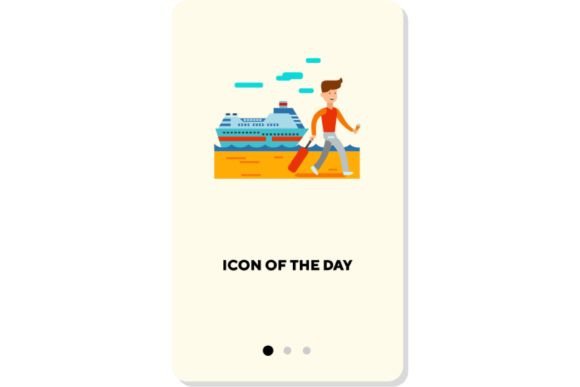
Travelling by Ship Flat Icon: Voyage Visuals
When we talk about visual communication in the digital age, clarity is king. While many designers obsess over serif font choices or the nuances of a handwritten font for branding, there is an equally critical component that often gets overlooked until the last minute: iconography. Specifically, the Travelling by Ship Flat Icon. Voyage by represents more than just a graphic element; it is a concise visual language that bridges the gap between complex logistical concepts and immediate user understanding.
This vector illustration symbol is not merely a decorative add-on. It serves as a functional anchor in web design and app interfaces, particularly for industries rooted in transportation, tourism, and global logistics. By isolating the vessel against a clean background, the design removes visual noise, allowing the core message—movement across water—to resonate instantly with the viewer. For entrepreneurs and content creators, understanding how to leverage such specific design assets can significantly elevate the professionalism of their output.
The Aesthetic Appeal of Minimalist Maritime Symbols
The charm of the Travelling by Ship Flat Icon. Voyage by lies in its adherence to flat design principles. Unlike skeuomorphic designs that attempt to mimic real-world textures and shadows, flat icons rely on solid colors, simple shapes, and clean lines. This approach aligns perfectly with modern typography trends, where sans serif fonts dominate screens for their legibility and sleek appearance.
Visually, this icon typically features a stylized hull, perhaps a hint of a cabin or smokestack, and subtle waves beneath. The lack of intricate detail is a strength, not a weakness. It ensures that the icon remains recognizable even when scaled down to the size of a favicon or a mobile navigation button. For brand strategists, this scalability is crucial. A premium font might look stunning in a headline, but if your supporting icons are cluttered or inconsistent, the overall brand identity suffers from visual dissonance.
Furthermore, the "voyage" aspect implies journey and adventure. When used in marketing materials, this icon evokes feelings of exploration and reliability. It is neutral enough to work for a cargo shipping company yet inviting enough for a luxury cruise line, depending on the color palette applied. This versatility makes it a staple in any designer’s toolkit, sitting comfortably alongside other essential creative font and graphic resources.
Strategic Applications Across Digital and Print Media
Where does this specific icon shine brightest? The applications are vast, spanning both digital and physical realms. In web design, it is indispensable for travel agencies, ferry booking platforms, and international freight forwarders. Placed next to a call-to-action button, it guides the user’s eye and reinforces the service being offered without the need for excessive text. This reduces cognitive load, a key principle in user experience (UX) design.
In the realm of social media graphics, the icon acts as a quick visual cue. Imagine an Instagram carousel post detailing the steps of importing goods. Using the Travelling by Ship Flat Icon. Voyage by as a bullet point marker creates a thematic consistency that keeps the audience engaged. Similarly, for bloggers and publishers focusing on travel narratives, integrating this vector into infographics can break up long blocks of text, making the content more digestible and shareable.
Print media also benefits from this clarity. In packaging design for imported goods, a small ship icon can indicate origin or shipping method subtly. For editorial design, such as travel magazines or brochures, the icon can serve as a section divider or a chapter header graphic. When paired with a bold display font for headings and a clean sans serif font for body text, the icon completes the visual hierarchy, ensuring that the reader’s journey through the content is smooth and intuitive.
Enhancing Brand Perception Through Consistent Iconography
Consistency is the cornerstone of professional brand identity. Just as you would carefully select a commercial font that reflects your company’s values, your choice of icons must align with your overall aesthetic. The Travelling by Ship Flat Icon. Voyage by offers a level of polish that signals attention to detail. When customers see high-quality, cohesive visuals, they subconsciously associate that quality with the service itself.
Consider the impact on readability and visual hierarchy. Icons act as signposts. In a dense interface or a detailed brochure, they allow users to scan for relevant information quickly. If your typography is elegant but your icons are pixelated or stylistically mismatched, the perceived value of your brand drops. By using a vector-based asset like this, you ensure crisp edges at any resolution, maintaining a look of sophistication and reliability.
Moreover, this icon supports audience engagement by transcending language barriers. A ship symbol is universally understood. For businesses targeting international markets, relying on visual symbols reduces the need for translation and minimizes the risk of miscommunication. This is particularly valuable for logo design elements or app interfaces where space is limited and clarity is paramount.
Practical Guidance for Integration and Licensing
Before integrating the Travelling by Ship Flat Icon. Voyage by into your next project, consider a few practical steps to ensure optimal results. First, evaluate the color scheme. While flat icons are often monochromatic, don’t be afraid to experiment. A deep navy blue might convey trust and stability for a logistics firm, while a bright turquoise could suggest leisure and fun for a vacation rental site. Ensure the color contrasts well with the background to maintain accessibility standards.
Second, think about font pairing. If you are using this icon alongside text, choose a typeface that complements its geometric simplicity. A modern sans serif font usually pairs best with flat icons, creating a harmonious contemporary look. Avoid overly ornate script font choices unless you are aiming for a very specific, contrasting artistic effect, as this can clash with the clean lines of the vector.
Finally, always verify the licensing terms. Whether you are a freelancer working on a client project or a small business owner updating your website, ensure that the design assets you use are cleared for commercial use. Many vector platforms offer different licenses for personal versus commercial projects. Understanding these distinctions protects you from legal issues and supports the creators who produce these valuable tools. By treating iconography with the same respect as typography, you elevate your design work from good to exceptional, creating a cohesive and compelling visual narrative for your audience.