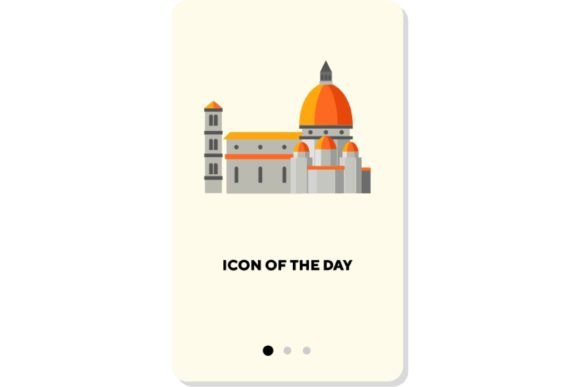
Country Landmarks Flat Icon. Church Buil: Enhancing Digital Tourism and Web Design
In the rapidly evolving landscape of digital design, visual communication has become paramount. Whether you are developing a travel application, designing a tourism website, or creating educational materials, the ability to convey complex ideas through simple, recognizable imagery is essential. This is where the Country Landmarks Flat Icon. Church Buil plays a pivotal role. As a specialized vector illustration symbol, it serves not merely as a decorative element but as a functional tool for guiding users, enhancing user experience (UX), and reinforcing thematic consistency in sightseeing and tourism concepts.
The term "flat icon" refers to a minimalist design style that eschews three-dimensional effects like shadows, gradients, and textures in favor of clean lines and solid colors. When applied to specific subjects like church buildings within the context of country landmarks, this style offers clarity and scalability. The Church building isolated vector sign is designed to stand alone, making it versatile for various layout requirements without the distraction of background noise. For designers and developers, understanding how to effectively integrate these elements can significantly improve the usability and aesthetic appeal of their projects.
Understanding the Role of Landmark Icons in Digital Interfaces
Visual symbols act as a universal language, transcending linguistic barriers. In the realm of tourism and travel, users often scan interfaces quickly, looking for specific types of information. A well-designed icon allows them to identify points of interest instantly. The Country Landmarks Flat Icon. Church Buil specifically targets heritage sites, religious structures, and historical architecture. By using a standardized yet distinct representation of a church, designers can create an intuitive navigation system for maps, itineraries, and location-based services.
One of the primary challenges in web and app design is maintaining performance without sacrificing quality. Large, detailed images can slow down load times, leading to higher bounce rates. Vector illustrations, such as the isolated vector sign mentioned, solve this problem. Because they are based on mathematical paths rather than pixels, they remain crisp at any size and have minimal file sizes. This ensures that your sightseeing and tourism concept remains responsive and fast, providing a seamless experience for users on both desktop and mobile devices.
Addressing Design Challenges with Vector Solutions
Designers often face the dilemma of balancing detail with simplicity. Too much detail in an icon can make it illegible at small sizes, while too little can make it ambiguous. The Country Landmarks Flat Icon. Church Buil strikes this balance by focusing on key architectural features—such as steeples, crosses, or arched windows—that immediately signal "church" to the viewer. This isolation of essential elements ensures that the icon is recognizable even when scaled down to fit into a mobile navigation bar or a dense map interface.
Another common issue is consistency across a design system. If one icon is realistic and another is abstract, the overall interface feels disjointed. Using a cohesive set of flat icons, including the church building symbol, ensures visual harmony. This consistency builds trust with the user, as it suggests a professional and thoughtful approach to the product’s development. For tourism apps, where users rely on accurate and clear information, this psychological cue is invaluable.
Practical Applications for Web Design and Apps
The versatility of the Country Landmarks Flat Icon. Church Buil extends across numerous platforms and use cases. Here are several practical ways to implement this vector illustration symbol in your projects:
- Interactive Maps: Use the icon to mark historical churches on tourist maps. When users tap the icon, it can reveal details such as visiting hours, historical significance, and entry fees.
- Navigation Menus: Incorporate the icon into category filters, allowing users to quickly sort attractions by type, such as "Religious Sites" or "Historical Landmarks."
- Itinerary Builders: In travel planning apps, use the icon to represent scheduled visits to churches, helping users visualize their day’s activities at a glance.
- Educational Content: For e-learning platforms focused on history or architecture, the icon can serve as a bullet point or section header, breaking up text and aiding retention.
- Social Media Graphics: Utilize the isolated vector sign in promotional materials for heritage tours, ensuring brand consistency across digital marketing channels.
Each of these applications leverages the icon’s ability to communicate quickly and effectively. By integrating the Church building isolated vector sign into these contexts, you enhance the user’s ability to process information and make decisions, which is the ultimate goal of good UX design.
Tailoring Approaches for Different Users
Different stakeholders will approach the use of Country Landmarks Flat Icon. Church Buil from unique perspectives. For UI/UX designers, the focus is on integration and accessibility. They must ensure that the icon contrasts well with its background and includes appropriate alt text for screen readers, ensuring inclusivity for visually impaired users. The flat design style aids in this by providing clear boundaries and high contrast options.
For developers, the priority is implementation efficiency. Vector formats like SVG are ideal because they can be styled directly with CSS, allowing for dynamic color changes based on user interactions or theme settings. This flexibility means the same icon can adapt to light and dark modes without requiring multiple image files.
Content creators and marketers view the icon as a branding tool. It helps establish a visual identity associated with cultural exploration and heritage. By consistently using this specific style of landmark icon, they reinforce the brand’s association with quality and clarity in the tourism sector.
Recommendations for Effective Implementation
To maximize the benefits of the Country Landmarks Flat Icon. Church Buil, consider the following best practices:
- Maintain Scale Consistency: Ensure that the stroke width and overall size of the church icon match other icons in your set. Inconsistent sizing can disrupt visual flow and confuse users.
- Use Semantic Color Coding: While flat icons are often monochromatic, using color strategically can enhance meaning. For example, use a distinct color for religious sites versus museums to aid quick differentiation.
- Optimize for Performance: Even though vectors are lightweight, ensure they are properly minified and compressed before deployment. This keeps your website or app running smoothly.
- Test for Recognizability: Conduct user testing to ensure that your target audience immediately identifies the icon as a church or landmark. If confusion arises, consider adjusting specific design elements like the steeple or cross to be more prominent.
By adhering to these guidelines, you ensure that the sightseeing and tourism concept is not only visually appealing but also functionally robust. The goal is to reduce cognitive load for the user, allowing them to focus on the content and the experience rather than deciphering the interface.
Conclusion
The Country Landmarks Flat Icon. Church Buil is more than just a graphic asset; it is a critical component of modern digital communication in the tourism and heritage sectors. Its ability to convey meaning instantly, combined with the technical advantages of vector isolation, makes it an indispensable tool for designers and developers. By understanding its role, addressing common design challenges, and implementing it thoughtfully across various platforms, you can create more engaging, accessible, and efficient user experiences. Whether you are building a comprehensive travel app or a simple informational website, leveraging high-quality flat icons like this church building symbol will elevate your project’s professionalism and usability.